
Gold exchange traded funds (ETFs) witnessed a net outflow of Rs 248 crore in February, making it the second consecutive month of withdrawals as investors preferred equities over other segments on record SIP flows. Net outflows from the gold ETFs were at Rs 452 crore in the month of January. Prior to that, the asset class had seen a net investment of Rs 313 crore, according to the data of Association of Mutual Funds in India (Amfi). Despite the outflows, the category witnessed an increase in net assets under management (AUM) of gold ETFs to Rs 18,727 crore at the end of February from Rs 17,839 crore in January-end.

Earnings growth is expected to accelerate as lingering toxic effects of note ban ease off and GST settles down. However, stock valuations are high and that means market is also overdue for correction, says Devangshu Datta.

Under the new guidelines, the top 10 active equity schemes in terms of assets would collectively require investments of around Rs 365 crore -- up from mandated Rs 50 lakh at present -- in their own schemes.

The Securities and Exchange Board of India (Sebi) could soon issue interim orders imposing a market ban on the two former fund managers of Axis Mutual Fund (MF) for suspected front-running of trades, said people with knowledge of the development. "The market regulator has gathered prima facie evidence that demonstrates that the duo has violated the integrity of the market. "While a detailed investigation is still pending in the matter, Sebi could take action under Section 11 (4) to prevent further harm to the investors and the securities market," said a source.

'EPFO's investments this financial year should be Rs 1 lakh crore'

Salil Dhawan explains how as you progress in your career you can also grow your money at a phenomenal pace if you start investing early.

Bajaj Finance was the top gainer in the Sensex pack, rallying over 4 per cent, followed by SBI, Tech Mahindra, Asian Paints, Bajaj Finserv, IndusInd Bank, ICICI Bank and M&M.

Reminiscent of the past two years, the market has made positive strides ahead of the Union Budget 2023-24 (FY24). The benchmark National Stock Exchange Nifty has gained 1.8 per cent in the last month. Typically, markets tend to gain ahead of the Budget as investors build in optimism.

The rupee on Friday rebounded from the near-80 levels to close higher by 17 paise at 79.82 against the US currency following a recovery in the domestic stocks and weakness in the greenback in overseas markets. The US dollar retreated from the two-decade high levels against a basket of six currencies which supported the rupee sentiment. At the interbank foreign exchange market, the local currency opened at 79.95 and witnessed an intra-day high of 79.82 and a low of 79.96 against the US dollar in the day trade. ,

Reflecting subdued global economic growth, India's outward foreign direct investment (FDI) fell by 33.3 per cent sequentially to $1.21 billion in August, compared to over $1.82 billion in July.

Whether it's Carrefour, Ford, or other foreign majors, they are ready to adjust their strategies and design their plans in a way that would address the Indian consumption story.

So, what does 2016 have in store for the Indian markets? Will they be able to take a giant leap forward in the leap year, and what are the key risks?

'At this moment, investors should look for relative value within sectors and clear visibility (third-wave-or-not) on earnings delivery.'

Stocks of Indian steel companies are reeling from pricing pressure that is partly blamed on cheap imports. The stocks have declined up to 9 per cent on the NSE in one month, likely allowing investors an opportunity to use the correction to enter the pack as pricing pressure eases. "In steel or any other commodity, if prices or spreads are nearing their bottom, it can be an opportune time to invest in those stocks.

In April, the inflows into equity schemes dropped 60% compared to the previous month to Rs 4,608 crore, the lowest since Sept 2016.
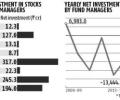
After relentlessly selling shares for most of 2013, India's equity mutual fund managers have turned buyers in the fag-end of the year.

Invest in MFs for liquidity and choice of funds. Invest in NPS for the tax benefits, tax-free rebalancing, and for earmarked savings for retirement.

The rupee weakened by 14 paise to close at a new lifetime low of 79.59 against the US dollar on Tuesday as a strong greenback overseas and persistent foreign fund outflows continued to weigh on investor sentiment. This comes a day after the RBI announced measures for international trade settlement in rupees. At the interbank forex market, the local unit opened weak at 79.55 against the greenback and witnessed an intra-day high of 79.53 and a low of 79.66.

Only a fifth of foreign portfolio investors (FPIs) in breach of the market regulator-specified thresholds may need to provide enhanced disclosure on ultimate beneficiaries, thanks to exemptions being provided, according to people in the know. The ultimate beneficial ownership (UBO) disclosures, for FPIs with over 50 per cent holding in a single corporate group or over Rs 25,000 crore exposure to Indian assets, will be required from February 1. But, depending on their category, FPIs will have 10-30 working days to submit these granular details.

'The government will take proactive steps to see that their participation in the equity market, especially in PSU stocks, is rewarding.'

'Periods of high volatility are usually bad for mid-caps and this is something that has to be kept in mind.' 'Focus on quality is of paramount importance.'

'Many do not have robust business models, and their prospects of survival and long-term growth are poor.'

'Liquid ETFs help in cash management by enabling a smooth transition between equity and cash within the same settlement cycle, as they trade in the same segment as equity.'

Amidst strained ties with China, the pre-budget Economic Survey on Monday made a strong case for seeking foreign direct investments (FDI) from Beijing to boost local manufacturing and tap the export market. As the US and Europe are shifting their immediate sourcing away from China, it is more effective to have Chinese companies invest in India and then export the products to these markets rather than importing from the neighbouring country, the Survey said.

On Monday, the biggest gainers in the Sensex pack were Sun Pharma, Bajaj Finance, Vedanta, Yes Bank, Tata Motors, HCL Tech, IndusInd Bank and Kotak Bank, HCL Tech, Infosys and Bajaj Auto.

Benchmark stock indices Sensex and Nifty closed with losses in highly volatile trade on Thursday as banking and financial stocks retreated amid a weak trend in global equity markets. The 30-share BSE Sensex declined 89.14 points or 0.15 per cent to settle at 57,595.68. During the day, it touched a low of 57,138.51 and a high of 57,827.99. The broader NSE Nifty dipped 22.90 points or 0.13 per cent to settle at 17,222.75.

'We have seen something do very well when the times are good but maybe not as well when the times are bad.'

The proposed move to withdraw the DDT would help encourage investments by addressing multiple taxation of income and bringing down the effective tax rate on companies, which is among the highest in the world.

Investors must be cautious and follow a prudent diversification strategy to mitigate against any risks in case of any unforeseen events.

Are you riding on the horses or on the laggards

'Markets are not expensive; they are fairly priced.'

Retail investors could be hesitant to invest in floating rate savings bonds, as these specific bonds tend to be profitable only in a rising rate environment, according to market participants. The Reserve Bank of India has allowed subscriptions for floating-rate savings bonds, 2020, via retail direct - an online portal that enables individual investors to purchase government securities.

Stocks offering attractive dividends contain downside better when the markets correct, advises Sarbajeet K Sen.

Certain foreign portfolio investors (FPIs), which operate as pooled investment vehicles (PIVs), may not be exempt from the additional disclosure mandates by the Securities and Exchange Board of India (Sebi) following an update in the standard operating procedures (SOPs) for custodians. An updated version of the SOPs has specified several conditions to be met for PIVs to benefit from the exemptions granted. These include no segregated portfolios, independent investment manager, and investors having pari-passu (equal) rights in the entity.

rediffGURU and financial planning expert Colonel Sanjeev Govila (retd) answers your personal finance-related questions.

This would be a 10-fold jump from $10-12 bn raised a year from Indian markets over past 2-3 years

Notwithstanding concerns about lofty valuations, smallcaps recorded their most significant monthly gain in nearly three years in November. The National Stock Exchange Nifty Smallcap 100 finished the month with a 12 per cent gain, the most since February 2021 when it rose by 12.2 per cent. After declining by 4.1 per cent in the preceding month, the Nifty Midcap 100 rose by 10.4 per cent, the most since July 2022.

Bharti Airtel was the biggest gainer in the Sensex pack, rising 2.37 per cent, followed by Mahindra & Mahindra, HCL Tech, Tata Motors, Tech Mahindra, HDFC Bank, Wipro, Tata Consultancy Services, Axis Bank and Nestle. Asian Paints, Hindustan Unilever, Bajaj Finserv and NTPC were among the laggards.

The rupee depreciated 39 paise to an all-time low of 82.69 against the US dollar in early trade on Monday as elevated crude oil prices and risk-averse sentiment among investors weighed on the local unit. Moreover, a negative trend in domestic equities and firm American currency sapped investor appetite, forex traders said. At the interbank foreign exchange, the rupee opened at 82.68 against the greenback, then slipped further to 82.69, registering a fall of 39 paise over its previous close.

Indian companies had invested $7.34 billion.
